



AI data centres are placing new demands on cooling systems.
As artificial intelligence workloads become larger and more power-intensive, servers and GPUs are producing greater amounts of heat. This heat must be removed continuously to protect performance, reliability and uptime.
For many high-density data centres, liquid cooling is becoming an important part of the solution. Instead of relying only on air to cool server rooms, liquid cooling allows heat to be captured closer to the source. Water or specialist cooling fluid can pass through the system, absorb heat from the equipment and carry it away through a controlled loop.
However, once that water has absorbed the heat, one important question remains.
Could that heat be reused before it is wasted?
Recovering heat from the cooling loop
In a liquid-cooled data centre, the cooling loop is designed to remove heat from IT equipment. Cool water enters the system, passes through the cooling circuit, absorbs heat from the servers and leaves warmer than it entered.
In many systems, that heat is then rejected through conventional cooling equipment.
However, there is another opportunity.
Before the heat is rejected, it could be transferred into a hot water or pre-heat system. This would allow the data centre to reuse some of the heat it has already created, rather than treating it only as waste.
This is where Fabdec Energy Blade technology could offer an interesting route forward.
Where the Energy Blade fits
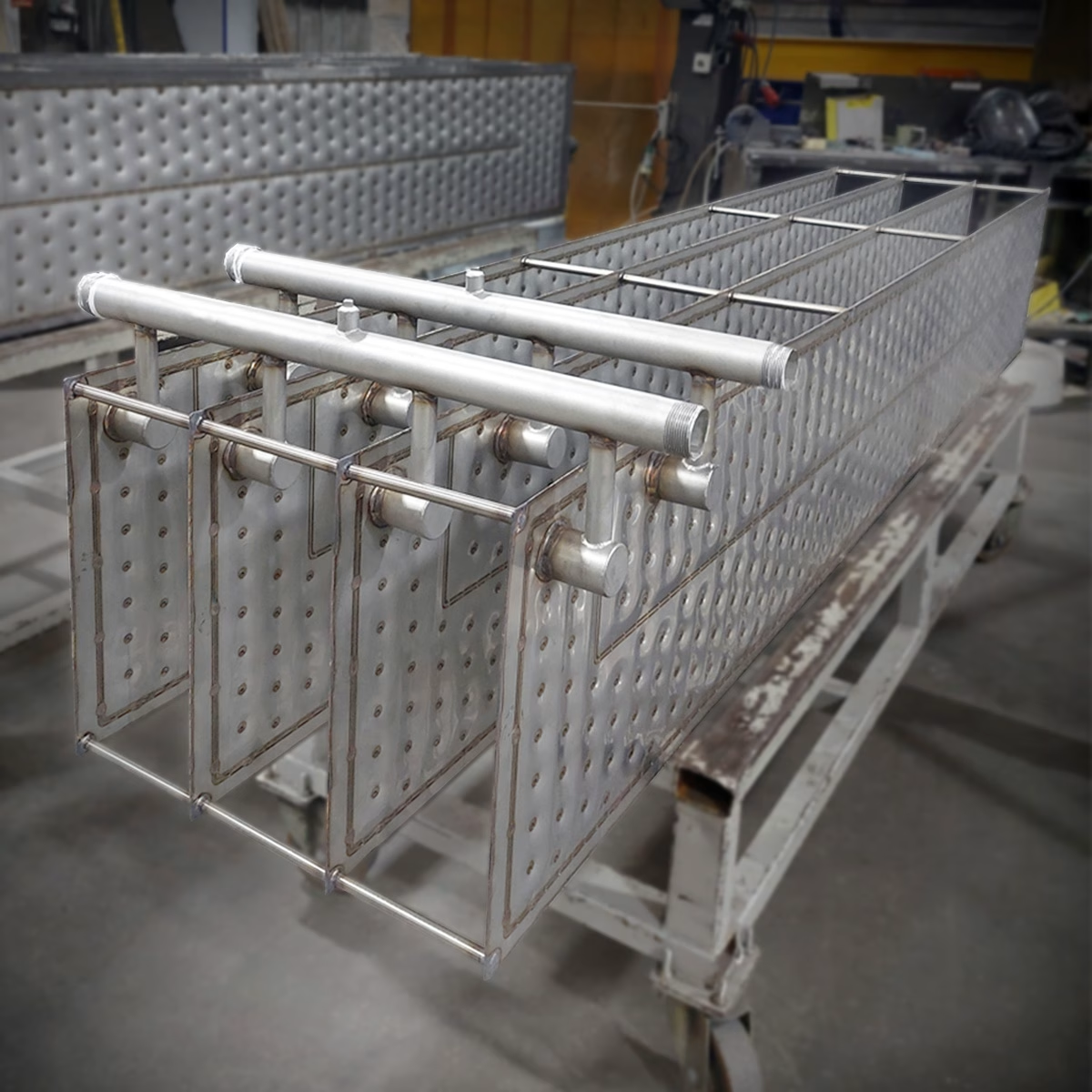
The Fabdec Energy Blade has traditionally been used in water-source heat pump applications, often installed in suitable bodies of water such as lakes, rivers, canals or reservoirs.
In those applications, the Energy Blade provides stainless steel heat exchange surface area, allowing heat to transfer between the surrounding water and a connected thermal system.
But the principle does not need to be limited to open water.
At its core, the Energy Blade is a stainless steel heat exchange product. It is designed to allow heat to move from one liquid environment into another system.
For data centre heat recovery, Energy Blades could potentially be adapted as a heat transfer stage within a closed liquid cooling loop.
In this version, the Energy Blade would not sit in a canal or river. It would form part of the controlled cooling circuit. Water would pass through the data centre cooling system, pick up heat from the servers, then continue through the Energy Blade section before returning to the cooling loop.
The Energy Blade would help extract heat from that warmed water and make it available for hot water generation.
The simple system principle
A simplified system could work like this:
1. Cool water enters the data centre liquid cooling loop
The cooling water passes through the server cooling system.
2. The servers heat the water
As the water moves through the cooling circuit, it absorbs heat from high-density IT equipment.
3. Warm water continues to the Energy Blade
Instead of immediately rejecting the heat, the warmed water passes through an Energy Blade heat transfer stage.
4. The Energy Blade transfers heat out of the loop
The stainless steel heat exchange surfaces help move recovered heat into a hot water or pre-heat system.
5. The cooled water returns to the servers
Once heat has been removed, the water can continue back through the closed cooling loop.
6. Recovered heat supports hot water generation
The transferred heat can help pre-heat or produce hot water for the data centre site.
This creates a more useful cooling loop. The system still removes heat from the servers, but it also gives the site an opportunity to reuse that heat before it is lost.
Using recovered heat for hot water
Data centres need cooling, but they can also have hot water demand.
Recovered heat from the liquid cooling loop could potentially support:
- washrooms
- staff welfare areas
- kitchens
- offices
- cleaning requirements
- plant room services
- pre-heating for commercial hot water systems
The recovered heat may not always be hot enough to produce final-use hot water by itself. That depends on the temperature of the cooling loop and the requirements of the hot water system.
However, even pre-heating can be valuable.
If incoming cold water is raised in temperature before it reaches the main water heating system, the primary heater has less work to do. A boiler, heat pump or immersion heater can then provide the remaining temperature lift where required.
This means the data centre can reduce wasted heat and make better use of the energy already produced by its IT equipment.
Why the closed-loop approach matters
The key advantage of this concept is that it keeps the system controlled.
The water used in the cooling loop can remain within a closed circuit. This helps maintain water quality, flow control and system reliability.
The Energy Blade would act as a heat transfer section within that loop, rather than relying on an open external water source. This could make the concept more relevant to data centres that do not have access to a lake, river, canal or reservoir.
It also changes the way Energy Blade technology is positioned.
Instead of being seen only as a water-source heat pump product, it can be understood as a stainless steel heat exchange solution that could be adapted for controlled liquid-based thermal systems.
Technical Specifications
| Item | Specification |
|---|---|
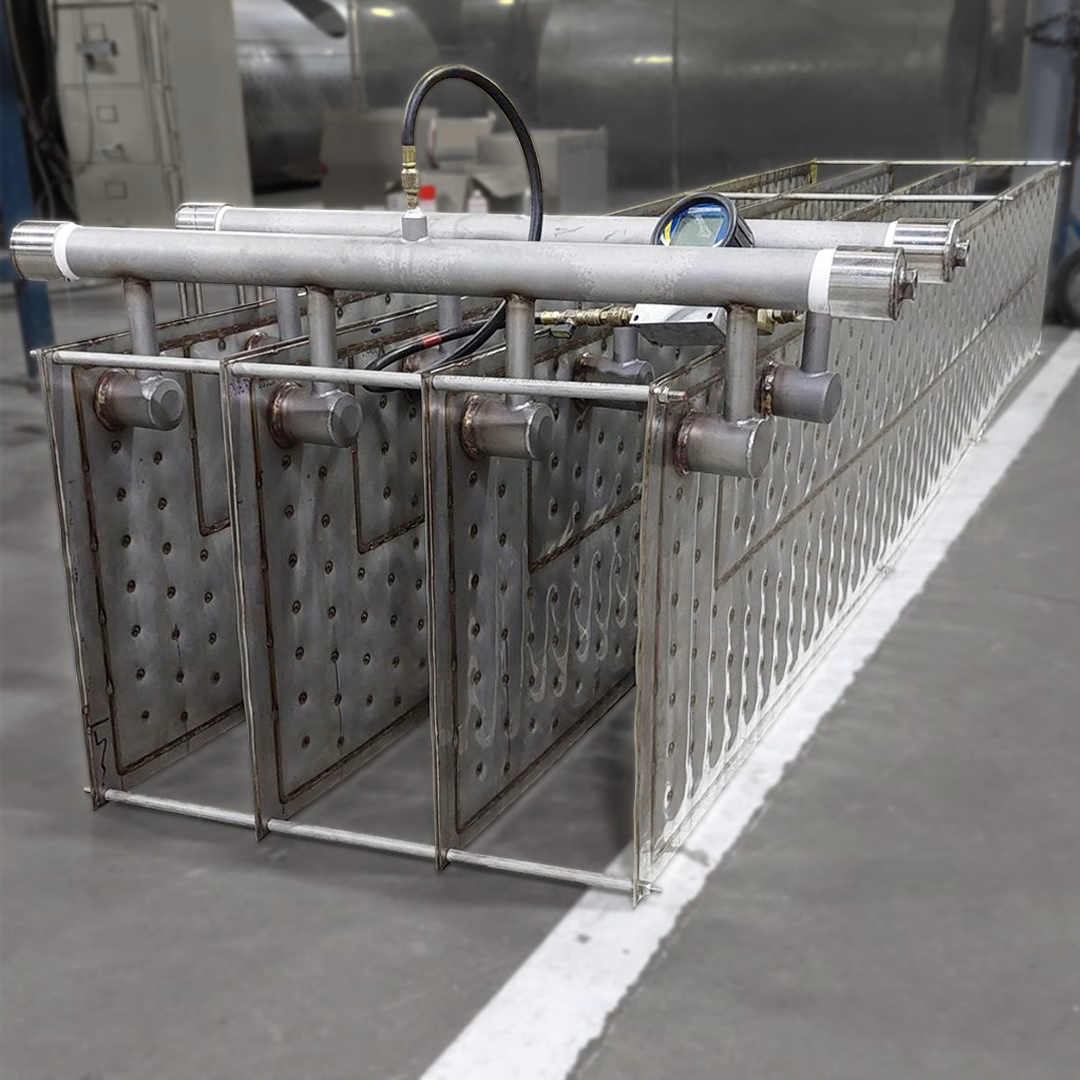
| Plate configuration | 4-plate array |
| Air vent fittings | 3/8″ Female BSP |
| Array volume (approx.) | 35 litres |
| Array height | 604mm |
| Array width | 785mm |
| Blade dimensions | 3,000mm x 492mm |
| Empty weight | 85kg |
| Manifold fittings | 1 1/2″ Male BSP |
| Material | Stainless steel 304-2B |
| Nominal flow rate | 1.2 litres/second |
| Pressure loss (design flow) | 25kPa (25% propylene glycol) |
Heat Transfer Performance
| Water Conditions | Heat Transfer |
|---|---|
| Still water | 8kW |
| Moderate flow | 15kW |
| Fast flow | 20kW |
All performance and specification data shown is based on a standard 4-plate array configuration. Alternative configurations are available depending on system requirements.
Nominal flow rate is based on standard system conditions and can be adjusted to suit system design and heat pump integration.
Designed around the application
Data centre cooling is mission-critical. Any heat recovery system must be designed so that it supports the cooling strategy without putting IT equipment at risk.
Important design questions would include:
- What temperature does the cooling loop operate at?
- What flow rate is required?
- How much heat can be recovered?
- What pressure is the system operating at?
- What fluid is used in the cooling loop?
- What hot water demand exists on site?
- Is the recovered heat used directly or as a pre-heat stage?
- Is a heat pump required to raise the temperature?
- What backup heating is needed?
- What redundancy is required?
- How will the system be isolated for maintenance?
These questions are important because every data centre is different. The correct solution would need to be designed around the thermal load, cooling infrastructure and site hot water demand.
Fabdec’s role would be to support that design with stainless steel heat exchange technology and bespoke thermal manufacturing experience.
Turning server heat into useful energy
The main proposition is simple.
The data centre already creates heat. The liquid cooling system already captures it. Energy Blade technology could help recover some of that heat before it is rejected.
This would allow a data centre to:
- reduce wasted heat
- support hot water generation
- reduce demand on primary water heating systems
- improve building services efficiency
- make better use of existing energy
- support lower-carbon site operation
- connect cooling infrastructure with hot water demand
The Energy Blade is not replacing the data centre cooling system. It is adding a heat recovery opportunity within the loop.
A new application for Energy Blade technology
Energy Blades have already been used as water-source heat exchange products. However, the same stainless steel heat exchange principle could have wider applications.
In a liquid-cooled data centre, the Energy Blade could potentially act as a controlled heat transfer stage. Warm water from the server cooling loop could pass through the Energy Blade, allowing recovered heat to be transferred into hot water generation before the cooled water returns to the servers.
This turns the Energy Blade into more than a water-source product. It becomes part of a wider discussion around heat recovery, liquid cooling and efficient thermal management.
From liquid cooling to hot water
AI data centres are producing large amounts of heat. Liquid cooling offers an efficient way to capture that heat, but the next step is deciding how that heat is used.
Energy Blade technology could provide a practical route for recovering heat from a closed liquid cooling loop and transferring it into hot water generation.
For data centres, this creates a simple opportunity:
Cool the servers. Capture the heat. Reuse it for hot water.
As AI infrastructure continues to grow, data centres will need to think beyond cooling alone. The most efficient sites will also consider how recovered heat can be turned into a useful resource.
Discuss data centre heat recovery with Fabdec
Fabdec manufactures stainless steel Energy Blades and thermal products for heat recovery, water heating and bespoke system integration.
If you are designing a data centre, liquid cooling system, energy centre or commercial heat recovery project, Fabdec can discuss how Energy Blade technology could be adapted to support closed-loop thermal recovery and hot water generation.
Contact Liam Bowen to discuss Energy Blade heat recovery for data centre liquid cooling systems.


